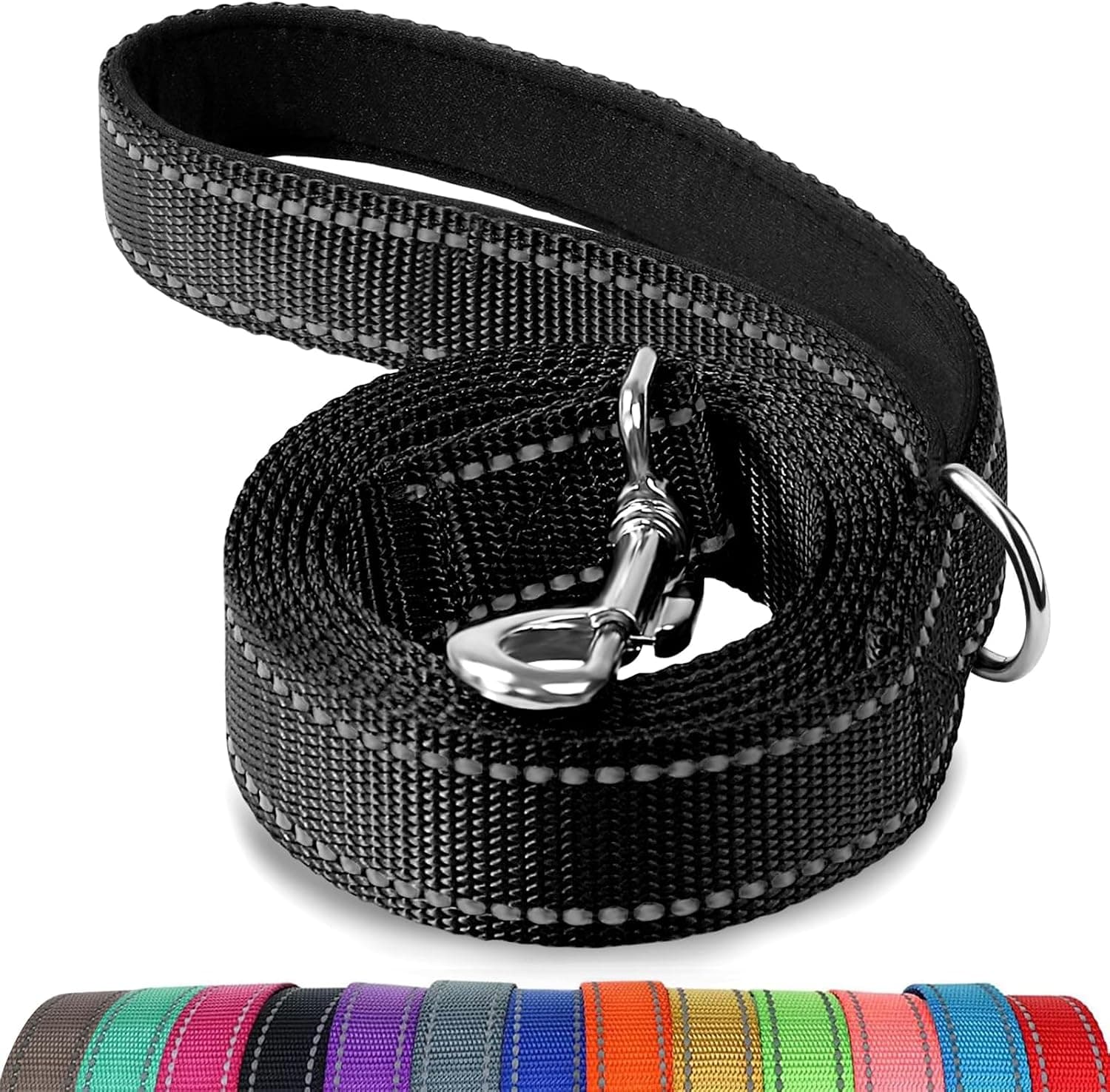
Hardware strength, grip comfort, and visibility — the three things that decide whether walking gear holds up to a puller. The failure point is almost never the webbing; it is the clip, the stitching, or the D-ring, so inspect the hardware before the fabric. Harness choice is where most of the decision sits. A back-clip harness is comfortable and gives you no leverage, which is fine for a dog that already walks well and useless for one that hauls. A front clip turns forward pressure into a redirect and is the practical choice while you are still teaching loose-leash walking. Collars are for ID tags and quick control, not for restraining a dog that lunges. Skip retractable leads near traffic: the thin line is hard to see, hard to grab, and gives you no control at the far end. Reflective stitching or a clip-on light matters more than anyone expects the first evening the clocks change.
For a dog that already walks on a loose lead, a flat collar is perfectly adequate and is the simplest thing to live with. For a dog that pulls, a harness is the better choice, because sustained pressure on the throat from a collar is a genuine risk to the trachea — and it is a much larger risk for small breeds and for flat-faced dogs whose airways are already compromised. A harness spreads that force across the chest. It is worth being clear that a harness is not a training device: it makes pulling safer, not rarer. The training is a separate job, and no piece of hardware substitutes for it.
Front-clip, back-clip, and what each actually does
A back-clip harness is comfortable, easy to fit, and gives you no mechanical advantage whatsoever — a dog that leans into it is pulling with its whole body, which is exactly what sled harnesses are designed to allow. A front-clip harness attaches at the chest, so a pulling dog turns itself gently sideways instead of moving forward. That does not teach loose-lead walking either, but it makes the walk manageable while you do teach it, and it is the option most owners of strong pullers find useful. Fit is what separates one that works from one that does not: you want two fingers under any strap, with nothing rubbing in the armpit.
Lead length, material, and the retractable question
A four-to-six-foot lead is the workhorse. It is short enough to keep a dog out of the road and long enough to let it sniff, which is most of what a dog gets out of a walk. Longer lines have their place for recall practice in open space and are a poor choice on a pavement. Nylon is cheap and fine; biothane is easy to wipe clean and does not absorb water; leather softens with use and lasts if you look after it. Retractable leads deserve a specific warning: the thin cord causes serious friction burns to hands and legs, the lock fails under exactly the sudden load you need it for, and the constant light tension teaches a dog that pulling is how you get more lead. If you use one, use it in open space and never near traffic.